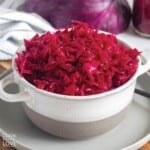
Red Cabbage Sauerkraut
Fermented red cabbage makes a tasty and tangy way to spruce up your meals. Discover everything you need to know to make the best red cabbage sauerkraut in your own kitchen.
Servings 8 servings
Calories 18kcal
Ingredients
- 1 pound red cabbage about half a large head
- 2 teaspoons kosher salt
Instructions
- If working with a whole cabbage, Place the cabbage head on your cutting board and cut in half.
- Place the flat edge of one half on the cutting board and cut it in half again vertically through the middle. Then cut each corner at an angle to remove the hard core.
- Remove any loose outer leaves, especially any that are limp or damaged.
- Slice each piece of cabbage into slices with a sharp knife. They can be as thick or thin as you prefer. Keep in mind, thinner slices will ferment more quickly.
- Place the cabbage in a bowl and cover with water. Gently swish it around to clean the cabbage. Transfer it to a colander and drain well.
- When dry, place the shredded cabbage in a large bowl and sprinkle the salt over the top.
- Massage the salt into the cabbage for up to ten minutes. As you massage, the cabbage will soften and release water. You should end up with enough water to submerge the cabbage in a jar.
- Pack the cabbage into a jar. Use a pestle, potato masher, or a smaller jar to press the cabbage down into the jar. Get as many air bubbles out so the cabbage stays submerged under the water.
- Place a small jelly jar or weight to hold the cabbage under the liquid. Place the lid on the jar. Set the sauerkraut in a cool dark place.
- Check your sauerkraut every couple days. Make sure it stays submerged under the liquid.
- It will begin to bubble after 1-2 days and then begin to smell more sour.
- Taste it with a clean fork to determine when it’s ready. You can eat it at any point and it really depends on the flavor you want. The cabbage softens more and the flavor intensifies the longer it sits.
- When it’s ready, place it in the refrigerator for up to six months.
Notes
Make sure your hands are clean. I like to wash and scrub my hands before massaging the cabbage. Alternatively you can use a pounder which also doubles as a tool to pack the cabbage in the jar.
Clean all your utensils. Make sure everything you have is washed well. If you have a dishwasher, simply running it through a heated dry should work great to sanitize everything well enough.
Leave about an inch of space at the top of your jar as the cabbage will expand as it ferments.
Lightly secure the lid when the jar is filled. You should be able to easily twist the lid open each day to release some of the gasses that build up inside.
If you see any signs of spoilage such as mold or excessive browned spots, you need to discard your ferment and start over.
Do not reduce the amount of salt in your ferment to make it less salty. The fermentation process needs a ratio of 2% salt to the weight of the cabbage (one pound of cabbage = two teaspoons of salt).
Nutrition
Calories: 18kcal | Carbohydrates: 4g | Protein: 1g | Fat: 0.1g | Saturated Fat: 0.01g | Polyunsaturated Fat: 0.04g | Monounsaturated Fat: 0.01g | Sodium: 597mg | Potassium: 138mg | Fiber: 1g | Sugar: 2g | Vitamin A: 633IU | Vitamin C: 32mg | Calcium: 26mg | Iron: 0.5mg
